
LONG BEACH LODGE #327
Free & Accepted Masons Of California
3610 Locust Ave., Long Beach, CA 90807
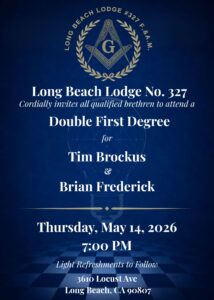
2nd Degree practice and 1st Degree Proficiency
Monday, October 26th, 6pm
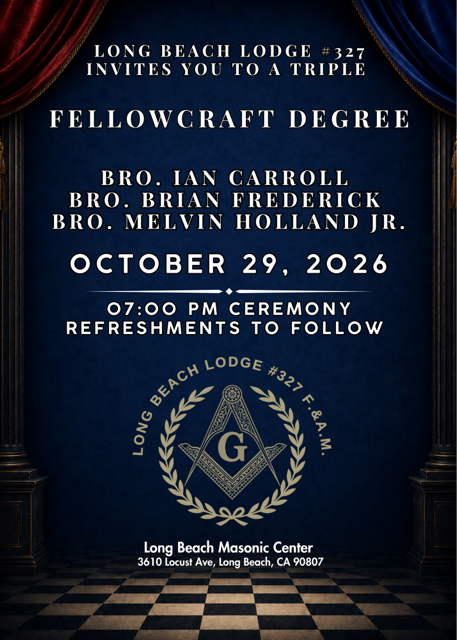
2nd Degree Conferrals
Thursday, October 29th at 7pm
If you are interested in Freemasonry please contact us with
the contact below and we will get in touch with you. Stay safe!
Meeting Information
We meet on Thursday Evenings.
Our Stated Meeting is on
the first Thursday evening
of the month at 8pm with a meal at 7pm
Sojourning and Visiting Masons welcome!
INTERESTED IN RENTING?
Visit the Facility Rentals page above!
Contact: Dawn’s email on the Facility Rental page
A Word From The Lodge
Let there be light!
Upcoming Events
Thursday, October 29th, 7pm
Three 2nd Degrees
Call: (562) 427-0821
We Look Forward To Seeing You!
Get In Touch –
We’d Love To Hear From You.
If interested, just ask!
All Masons Are Welcome
Established in 1896 .
Meets Thursday evenings –
Stated Meetings, for Masons, are on the
1st Thursday evening of the month at 8pm.
There is a dinner at 7pm ,before the meeting,
Visitors may attend the dinner.
We welcome Sojourners and Visiting Masons.
A Little About Us
Long Beach Lodge began when Long Beach was just a little city near the beach on a floor above a bank in 1896.
June Message from the Master
June also brings Father’s Day a day that honors one of life’s greatest responsibilities and privileges: being a father. Leadership within a family is not simply about providing; it is about setting the standard through character, discipline, integrity, and example. Good fathers work tirelessly to support and guide their families, raise honorable young men and strong, respectable young women, and serve as steady role models for future generations.
It is not an easy responsibility. The role demands strength and humility, toughness and compassion, discipline and patience. A father should be the example his sons strive to emulate and surpass, and the standard his daughters look to when understanding the respect, character, and values they should expect from others.
This Father’s Day, keep it simple. Share a good meal, embrace the people you love, and appreciate the moments that matter most. Those are often the memories that endure.
Continue the good fight. Lead by example. Live in a way that earns the respect and admiration of others — not through words alone, but through consistent action and unwavering character.
Calendar Events:
o 06/04/26 Stated Meeting 8p
o 06/11/26 1st Degree Conferral 7p x2
o 06/18/26 Bowling Night Reschedule
o 06/25/26 OSI Norwalk 2nd Degree
June Message from the Senior Warden
June Senior Warden Article
The Four Cardinal Virtues
May 23, 2026
The Four Cardinal Virtues can be examined and explained using the three degrees of the blue Lodge and basic numerology. Temperance being the first of the Virtues can be seen as relative to the initiate of Masonry as well as representing the point of creation, as the number one does; Fortitude being second and Prudence third can be contemplated using aspects of the FC and MM degrees—the number two represents the joining or duality of all things followed by the perfect or sublime nature of the number three is a representation of completion; and, Justice as the fourth Virtue, is an integral part of that which the three degrees of this progressive science prepares one to attain and uphold—the work within the first three stages / Degrees is realized in the fourth which is an expression of materialization and also the number four.
What is Temperance? The answer will vary among Masons. This is expected as we are instructed to proceed through our stations in life as a free thinking, just, and upright individual. In general, the word most often associated with this Virtue is patience. However, for the purpose of this article, Temperance—the first Cardinal Virtue—will be expressed as follows: the beginning; a thorough self-assessment and in turn the creation of a humble, noble, and sound foundation; this readies one to constructively and positively engage with all that exists. In sum, Temperance is the preparation of ones-self by: self-inquiry (Ask), analysis and development (Seek), and an establishment of the willingness to venture outside ones-self to engage and learn about others (Knock).
Temperance is the first of three virtuous attributes while it is also the beginning of a three-fold process of developing the tools and methods necessary to be a steward of righteousness.
What is Fortitude? The most accessible answer is expressed as courage. Fortitude can also be viewed as: the self-assurance that results from establishing a noble and honorable foundation within ones-self; the advancement from focusing on self-assessment to that of addressing others knowing that one has established within ones-self a foundation of humility and assuredness; this stage is the point-of departure for the fellow to begin his work, to begin seeking with confidence.
In sum, Fortitude is the second of the three virtuous attributes and coupled with the first, it creates a balance necessary to advance toward the third. Establishing the balance or duality of the first two Virtues is confirmation that one is ready to consider the work necessary to attain the components of the third.
What is Prudence? Wisdom is the word most often used to express the meaning of this Virtue and it is absolutely appropriate. However, following the framework of the article, Prudence can also be expressed as follows: the culmination of the first two Virtues which allows one to easily interact constructively and positively with all others; the final stage of honing ones-self for the goal of becoming an individual prepared to practice righteousness.
Therefore, Prudence is the third and final virtuous attribute in the sequence of steps to become a practitioner of righteousness, and is this the stage where one becomes enlightened.
Finally, what is Justice? Most assuredly it is that which the upright human being seeks to deliver and receive; and in many cases, retribution is unfortunately associated with this Virtue. However, Masonic Justice can be expressed as righteousness, and for the purpose of article, this expression is fitting, with the following addition: Justice is righteousness in practice. As the fourth Cardinal Virtue, Justice can be expressed as the Mastered individual putting into practice the first three Virtues or the materializing of the Virtues that have been honed within. In other words, the Cardinal Virtue of Justice can be expressed as an attribute of action used to transform the external or material world, as opposed to the preceding attributes which are used to transform ourselves internally.
Masons begin the process of becoming a just individual by tempering themselves using humility, responsibility, and honor as an EA. Once proficient in this first stage or degree, they assuredly advance with a solid foundation and tools to begin honing the attributes needed to Work as a FC. Once proficient in merging the dichotomic attributes of humility and assuredness they are admonished to take their honed abilities and perform the Work at-large as a MM. Finally, becoming mastered in the preceding three stages and the attributes associated with them allows one to actively participate in creating and maintaining Justice and righteous in the world.
June Message from the Junior Warden
Greetings from the South Brethren! We are nearly half way through the Masonic year, which means summer is nearly here. Summer usually means, hotter days, vacations, fairs and BBQs! I would like to mention early on that we will be having a Lodge BBQ in the following month of July! We will be cooking on site with the grills on the courtyard, so if anyone is interest in helping cook, grill or even smoke let me know! As for this month we will be having a new Lodge favorite again. Chicken Alfredo and Beef Spaghetti Meatball, Garlic Bread, Grilled Veggies, Mixed Berries, Salad and Ice Cream. Looking forward to seeing you all there and all family members are most welcome!
Fraternally,
David Kinnison
Junior Warden
2026 Dues info from the Secretary
Brethren of Long Beach Lodge,
Our Membership Dues for 2026 are $163.00
You can pay online at freemason.org for just a few more dollars.